Showing posts with label International Development. Show all posts

Wednesday, July 22, 2015

Internship Blog: Abraham Kim Post #4

A Week Remains 

Told you I was terrible at blogging. Two months later (already!), my work is finished.
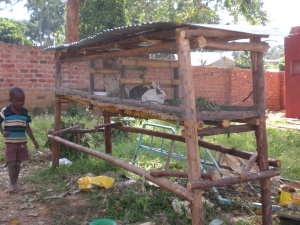
Bright Kids Uganda, the children’s home that I’ve been interning with, has about 100 children now and provides food, shelter, and an education for all kids. In order to have funds for this, they do receive donations majorly from the States, Canada, and UK, but they also have income generating projects. So in addition to the already existing projects, I wanted to bring in rabbits into the mix.

CIMG4236


I built a 3 roomed rabbit hutch and a 2 roomed rabbit hutch. I taught the kids, warden, and matron what to feed it, how often, and how to breed and handle the rabbits. I started with 3 rabbits. The two roomed hutch will be used for the baby rabbits. The kids named the whitest female rabbit Snow White. Then the other female, Cinderella. Lastly, they named the male rabbit… Abraham.

Saturday, June 13, 2015

Internship Blog: Abraham Kim Post #3

I was walking through Baito Market (an outdoor market where they sell anything from seasonal vegetable, fruit, fish (dried and fresh), and other meats to selling appliances and other random things you could need). In the vegetable section, where I was surrounded by green bell peppers, watermelons, cabbage, tomatoes, and onions, there were these stones, also for sale. I confusedly looked at them and asked the lady what these were for. She looked at me. She understood me, but she didn’t respond. I asked again, and she smiled but bit her tongue. Another lady selling vegetables behind me laughed and told me the stones were for pregnant women. It was pretty interesting so I continued with my questions as this lady was much more comfortable in talking about it. This stone is traditional medicine for pregnant women and they stir the stone in water to let it dissolve and the woman drinks it. Apparently it lessens the pain of giving birth. The lady continues and says the stone has lots of minerals and tells me to try it. Well, I didn’t want to buy a full stone that I can’t really use, so I asked the first lady if I could test it, just take a lick or something, and she decided to break off a small piece.

OLYMPUS DIGITAL CAMERA

I licked it and didn’t taste like anything so I decided to keep it as a souvenir. I brought it home and left it on the table and since power went out and dinner was late, my ‘maid’ (it’s weird calling her my maid but she cleans my room and cooks my food) brought me my food to my room for the first time and sees the stone. She laughs and starts asking me questions as to why I have this stone. I tell her I just want to take it home as a souvenir and she quietly looks at me for a while and then asks, “Who is the pregnant woman?”

Disclaimer: No women were impregnated

Friday, June 12, 2015

Internship Blog: Abraham Kim Post #2

With no surprise....

My first post in Uganda is about food. Most of the dishes are very similar to Zambia’s dishes. Most of the fruit are also the same. However, I could not be more wrong thinking that there was such a place that had more bananas than Zambia. The number of trucks carrying charcoal in Zambia equated the number of trucks carrying bananas in Uganda, and if you don’t know how many trucks of charcoal there were in Zambia, let’s see… In a small town, you might see about ten trucks. I guess that doesn’t really help either since most of you don’t know what I mean as in a small town, but you sort of get the idea. TONS of bananas.

However, that isn’t the highlight of this food post. The first day of being in Uganda, it was impossible to not notice these huge spiky looking things hanging from trees. I thought to myself, these can’t be edible. They are so huge with an oblong shape. These are Jackfruits.

10421305_10152871116507633_8344783472002091540_n
(In my compound)

It was my first time seeing and hearing of such fruit, but it’s grown in most tropical areas including other countries in Central Africa, India, Bangladesh (it’s their national fruit), and other Southeast Asian countries, and I am SO glad I tried it.
The inside of a jackfruit (Google image)

The texture was strange yet the taste was sweet. No matter how much I thought of which other fruit it reminded me of, I couldn’t think of any. It was like a mixture of a melon, pear, and I don’t even know.

How it's served (Google image)
How it’s served (Google image)

Once I got internet (during the 2nd day), one of the first things I did was look up Jackfruits and it actually fell under the same category as mulberries. WHAT? I don’t see the connection AT ALL considering the taste, appearance in both fruit and tree size, and leaves. Well, it’s Wikipedia so it must be accurate. It also taught me that Jackfruits are very nutritious. It’s a good source of protein, Vitamin C, and Iron. As much as I love meat, I might be okay with just eating Jackfruits all day.
I had it with every supper so far except today. After such a fun-packed day, what a sad way to end it.

Thursday, June 11, 2015

Internship Blog: Luke West Post #4

Internet and Stuff


Ah, to the age before internet. What did we do?  Since my last post, I spent six consecutive, solitary and isolated days without the all-powerful and all-knowing that is the internet.  This happened because I went on a trip away from the friendly confines of Bangalore to a town of roughly equal size in Hyderabad, about an 8 hour bus ride north.  Going in I didn’t realize I wouldn’t have internet, but the thought of not having it didn’t really bother me.  A nice relaxing time to clear your mind and not worry about the world afar, but focus on the world around you. Sure, it sounds nice, and was, for about the first 24 hours.

Then reality set it. No updates on the Buccos (who I’m glad are playing well), no Stanley Cup finals highlights, no newborn babies or wedding announcements (gag) on Facebook. No Netflix, no HBO, no news, no random google searches.  It’s amazing how many times I wanted to quickly google something on my phone, or check the weather, or look at a map, only to be disappointed. In the rather slow and boring pace I’ve come accustomed to since I’ve been here, the internet is my only slice of sanity.  Being away from friends and family and people to interact with, the internet and its updates I’ve, regrettably, started to cling to. It’s one thing when you’re out camping or something similar where you knowingly shut yourself off from the outside world. It’s another when everyone else around has wifi or 3g or 4g and you’re stuck in the 90s.

One positive I will take from the experience is that I managed to read, a lot. I’ve been reading a ton since I got here, there isn’t too much else to do besides peruse the internet and watch Netflix.  Without the internet for six days I actually managed to read a book and a half, Great Expectations by Charles Dickens, excellent, and most of Cat’s Cradle by  Kurt Vonnegut, excellent as well. I already finished Graham Greene’s Orient Express and am deciding whether to start Moby-Dick or The Three Musketeers. If you can’t tell I like classics, and what a better opportunity to read them than by being here. The absence of internet made it wonderful to read. But again, only for so long. Any reading I’ve done over the past 10 years have been in small spurts between TV and/or Internet sessions or before bed. Having reading as the only form of entertainment is, different.  It sort of brought me into some of the older books, when this really was the only form of personal entertainment.  I did have my phone still, not like anyone can contact me though, and I have gotten really good at Spider solitaire and Golf solitaire and managed to snap a few pictures inbetween.

OK, Internet and technology complaining aside, my six day trip to Hyderabad was actually very interesting.  I could write three more paragraphs on the trip, but I digress. First off, Hyderabad was one of the worst hit of the recent heat wave. Fortunately, it eased the day before we arrived, but it was still hot. We were there to do what Varghese has been doing for 15 years which is leadership and development workshops.  The participants here were members/volunteers of a Christian leadership group called Inter Collegiate Prayer Fellowship (ICPF).  They were a great, fun, funny and interesting group of guys from all over Southern India. What they and ICPF do is work with troubled university aged kids to help them overcome problems of addiction, stress, relationships, etc. through Christianity.  Our goal was to facilitate a workshop covering the basic themes of leadership, peace building, problem solving, communication, cooperation and teamwork.  The sessions of the four day program involved incorporating these themes through various activities, games, songs, prayers, and discussions aimed both at the participants, but also so that the participants can use them for their own work with teens.

The workshop and the ICPF guys were a blast, we stayed in one of the member’s apartment where everyone enjoyed authentic Indian meals for breakfast, lunch, and dinner. A quick trip to the ER and a couple of injections later I learned of my first ever allergy, mangoes (which is a shame because they are delicious and sold on every street corner). I had my first truly authentic Chicken Briyani, a dish common in India but native to Hyderabad, which is chicken that is slow cooked within the rice both full of flavors and spices.  We concluded the trip with a day a relaxation with friends of Varghese, I had another allergic reaction to mangoes, and then we took another overnight bus back to Bangalore. Bangalore, with its cool, cool temperature of like 90 (seriously it’s much nicer than Hyderabad, but I’m still sweating as I write this) and it’s glorious wifi.

image

Friday is a trip to a rural village outside of southern town called Salem.  With my fellow volunteer/intern “My dad ate the ‘e'” Stanly, we’re to visit a school to help write a grant proposal and also visit a leper hospital. The latter of which I’m excited and sort of nervous. I mean, leprosy is still a thing? First world problems.

This was a rambling blog post as the power has been out and it is dark and I had to do something before my computer dies and I’m left in total isolation.  Also, power outages are daily occurrence in India and can last from a few minutes to well over an hour like this one. END.

Tuesday, June 2, 2015

Internship Blog: Abraham Kim Post #1

New Blog (Again)

I’m terrible with journals. I am worse with blogs. This is my 3rd blog and the average number of posts for my previous two is probably 3 posts. The name of the blog didn’t help either. It had always been “Abein[country]” and so there was always going to be an end to those blogs since I eventually came back home. So, hopefully with this one, I can blog about all my adventures no matter where I am.

So where will I be next? In T-30 hours, I will be on a 54 hour trip. That includes all the time changes and the 13 hour layover in Dubai, and so the flight time is probably around 30 hours. Well, eventually, some time on Thursday June 4, I will have arrived in Entebbe, Uganda: my new home for the next two months.

What will I be doing? Work. I wish I was vacationing and seeing all the beauties of Uganda. I’ve never been to Uganda, but I know there are gorillas, guerrillas, and a lake. I wish I could see what more Uganda has, and I do know there’s a lot more. While I was in Zambia for the Peace Corps, prior to arriving, I knew … nothing about Zambia. Some people know at least Victoria Falls, but I knew nada. However, while living there for a while, there were hidden gems that I would LOVE to go back in a heartbeat. Uganda definitely has these and I really want to find them. However, I’ll be there for work.

As boring as work sounds, I could not be more excited to be surrounded by happy children playing silly games (which of course I love) and eating corn porridge. Not sure what it’s called in Uganda but nshima in Zambia, nsima in Malawi, bop in South Africa, Ugali in Kenya and Tanzania, you get the idea.

I’ve rambled a lot without answering exactly what I will be doing. I plan to monitor and evaluate income generating projects at the orphanage. The organization, Bright Kids Uganda (BKU), have sponsored children for schooling for a while now and these are children who were saved from the Lord’s Resistance Army (LRA), orphaned, or vulnerable from abusive families or families who could not financially support them. Now, BKU has nearly 100 children at their orphanage and they need a sustainable source of income. So, a few years back they started some initiatives with the help of volunteers, including several from my own graduate school (Graduate School of Public and International Affairs), and started a mini-supermarket, chicken poultry, microloans, and other small businesses. BKU also received a grant that will allow some of these projects to be expanded or completed and I will be following up on these projects. In addition, I hope to introduce a new income generating activity: raising rabbits. I did a bit of this during my service in Zambia and since rabbits are beneficial, cheap, and easy to breed, I hope to bring this into the mix of their projects.
All of that in two months. I wish I had more time, but I’ll just have to make the best of it.

Meet the GSPIA Summer Internship Bloggers!!

Summer is just around the corner, which means that our summer internship blogs will be back again soon!  Meet our bloggers:

Crystal Christophe - MPA, Public and Nonprofit Management
Amizade - Pittsburgh

RJ Susko - MPA, Urban & Regional Affairs
Borough of Castle Shannon - Pittsburgh

Mike Duane - MPA, Policy Research & Analysis
VoxUkraine - Kyiv, Ukraine

Topher Hoffman - MPA, Public & Nonprofit Management
New York City Department of Health & Mental Hygiene - New York City

Cynthia Caul - MID, Nongovernmental Organizations & Civil Society
City of Asylum- Pittsburgh

Anthony Griffith - MPIA, Security & Intelligence Studies
Allegheny County Sheriff's Office - Pittsburgh

Luke West - MID, Human Security
Daya Center for Peace - Bangalore, India

Abraham Kim - MID, Nongovernmental Organizations & Civil Society
Bright Kids Uganda - Kampala, Uganda

Qianyu Mo - MPA, Urban Affairs & Planning
Local Government Academy, Churchill Borough - Pittsburgh

Ann Kaufman - MPIA, Security & Intelligence Studies
Misericordia University - Dallas, PA
10th Congressional District of PA, Congressman Tom Marino - Williamsport, PA 


Tyler Dandrea - MPIA, Security & Intelligence Studies
US Senator for NC Richard Burr - Washington DC


We're looking forward to following along on their adventures this summer....stay tuned for upcoming posts! 

Wednesday, August 13, 2014

Internship Blog - Alyssa Cypher, Post #2


Language Studies While in Graduate School

I'm writing this blog post from my dorm room in Podgorica, Montenegro! Podgorica is a gorgeous city full of contrasts - crumbling socialist Yugoslavia-style architecture against a background of gorgeous mountains. It's very different from Zagreb, Croatia (where I studied three summers ago), which reminded me a lot of Pittsburgh. Podgorica is like no city I've ever been to, and I hope to describe it in more detail once I've been here longer than a week. 

Now that I'm taking a break from my internship to immerse myself in a new culture, I figure this will be a good chance to discuss language study while in graduate school. Trying to fit a language study into your schedule can be a challenge; however, I truly believe language study is worth the extra time and effort. Here are some ways I've made language study easier for myself:

The FLAS!
During my first year at GSPIA I was on a Foreign Language and Area Studies Fellowship (FLAS) from the US Department of Education. The FLAS is a government fellowship available in a number of areas and languages. To apply, your university must have a designated National Resource Center (NRC) in your chosen language group. For the 2010-2013 grant period (NRC status is renewed every four years), Pitt had NRCs in Latin American, International, and Russian/East Europe/Eurasian studies. The fellowship pays full tuition plus a sizable living stipend (mine was $18,000) for language and area studies in your chosen language. If Pitt offers a FLAS in a language you are interested in, I highly recommend applying! Applications usually go out around December for the following academic year. 

Summer Study Abroad and the Summer Language Institute!
Studying abroad is a great way to learn or improve your language skills. If you want to focus on language studies, the Summer Language Institute (SLI) is a great time-saving option for learning Russian/East European/near East languages - you can take two semesters-worth of language instruction in 6-8 weeks! These courses are intense (5 hours a day, 5 days a week, 6-8 weeks long), but highly effective and a perfect option for students who cannot fit language study into their academic year course schedule. In addition, SLI offers month-long study abroad language courses in several different cities - I'm currently doing four weeks of intensive Montenegrin (or BCMS) in Podgorica. I also need to note that this is my third summer spent participating in an SLI program - a testimony to the awesomeness of SLI.

Overall language study in graduate school, while not easy, is not as difficult as it seems. The resources are out there if you search for them. Here are links to information about the resources I've talked about - the FLAS (http://www2.ed.gov/programs/iegpsflasf/index.html) and SLI (http://www.slavic.pitt.edu/node/243).


Until next time!

The view of Podgorica from my dorm

Thursday, July 3, 2014

Internship Blog - Allie Reefer, Post #4

Fountain at Kaštel-Ečka, a hunting-lodge turned hotel in Ečka, Serbia
With only a month left in Belgrade, I’ve had plenty of time to evaluate my experiences here, to see what it takes to actually combat human trafficking in this region and to see if working in/with this region is actually something I want to do.

My time here certainly hasn’t been easy, and sometimes, it’s been downright discouraging. I’ve learned that in order to work in most organizations abroad, you have to have a working knowledge of the language to be of any significant help. I’ve been able to work on English-language grant proposals and put together information about labor trafficking in the region, but every meeting and training seminar I’ve attended has been in Serbian. Knowing the language hasn’t been much of a hindrance except in being able to fully grasp the opinions, thoughts, and understandings of people on the issue of human trafficking. And thankfully, I’ve met enough people working with trafficking who speak English to be able to get a better grasp. 

Most Ljubavi (Bridge of Love) in Vrnjačka Banja, Serbia
 But that hasn’t been my only discouragement. Being in the international development field (at least for me), makes it easy to go between feelings of unrealistic ambition and hopeless resignation. One minute, I’m dreaming about implementing long-term solutions to human trafficking in Eastern Europe, and the next, I’m wondering if I should have just stuck with a journalism career after all. Whether I’m in Serbia or the United States, these feelings often come from gaining the knowledge of what types of projects will target root causes of modern-day slavery followed by the realization that no one is actually bothering to carry these solutions out. Because they take time. And money. Two things that, in our fast-paced world, are hard to come by and not willingly or easily given out.


The overwhelming, and usually pessimistic, thoughts have flooded my mind almost every day: How am I ever going to learn these languages? What do I really have to offer these countries and people? If no one else is actually implementing long-term change, how will I do it? Should I just worry about taking care of the victims rather than preventing more trafficking from, inevitably, happening?

After five years of dedicating my time, resources, energy, and academics to this topic, it can be really disheartening. What if everything I’ve done is in vain?

And then I have to stop myself—because ultimately what I’m doing is not about me at all. Sometimes I get frustrated in certain classes or even conversations because to a lot of people, human rights and human development are means to an end, but to me, these are the end. National security, economic prosperity, global influence and power—these mean nothing if a majority of the population is not only living in squalor but intentionally being neglected. According to economics or security or politics, enabling human growth and focusing on human rights may not be the most beneficial path. But a human life is more important than even a million of the most valuable currency on earth.

For me, that’s enough to keep going because I ultimately know that this is what I should be doing with my life. I don’t know if I’ll ever become fluent in Russian, or learn any other Slavic languages for that matter. I don’t know if I’ll be working in Vienna or DC or Pittsburgh. I don’t know if my name will be someday known globally or only by my friends and family. But it doesn’t matter, really.